Yoga Retreats
UK Yoga Retreats: The Complete Guide to Booking the Right One in 2026
By the Carefree Retreat team
Updated 2026
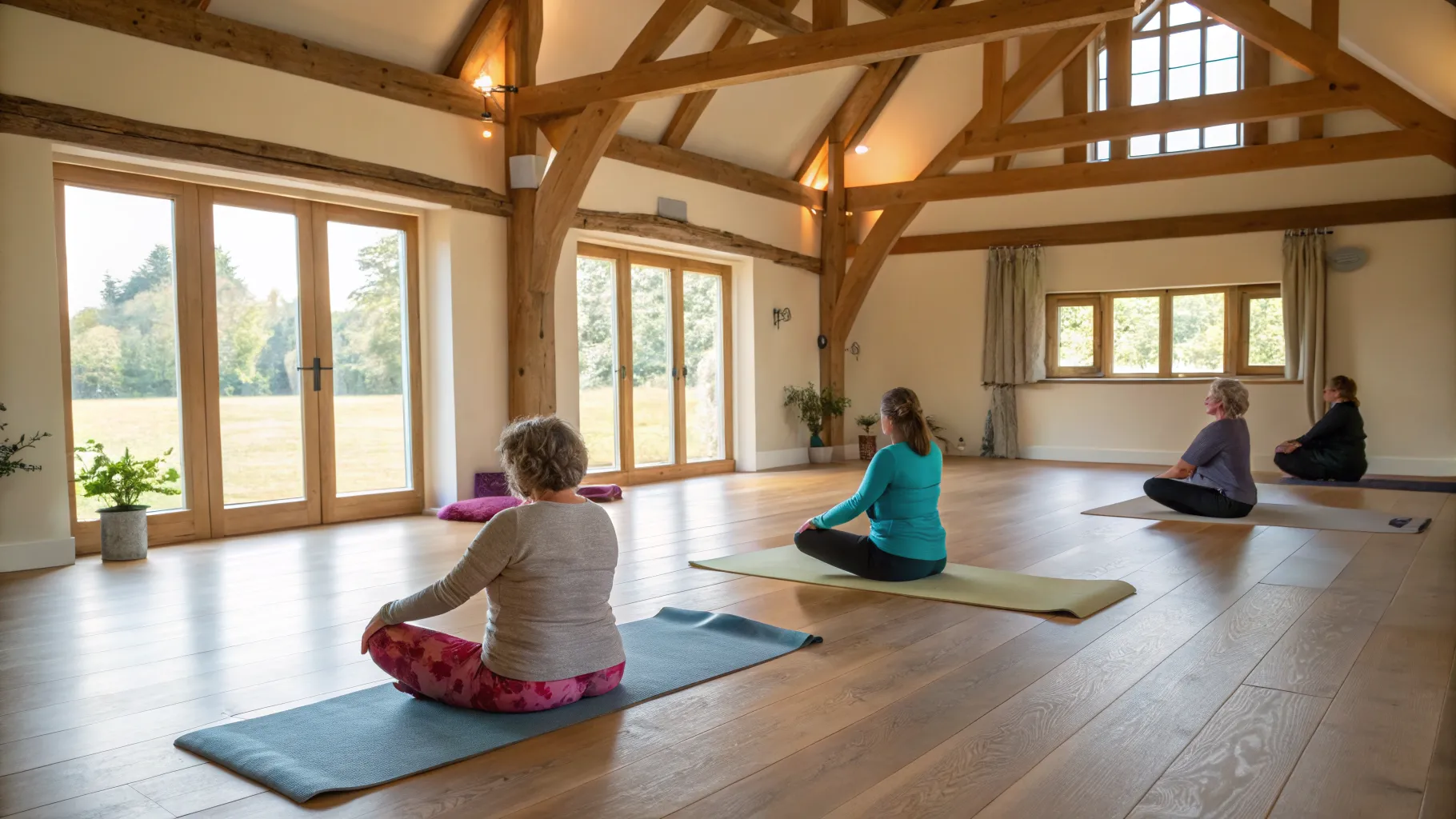
Picking the right UK yoga retreat is less about finding the most photogenic farmhouse and more about reading the small print before you pay a deposit. The yoga part is easy: every reputable retreat will look after a complete beginner. The parts that actually trip people up are the single-occupancy supplement that quietly inflates the price, the cancellation terms that decide whether you lose your money if life gets in the way, and the question of whether your booking is financially protected at all. This guide covers all of it: real price ranges, what is and is not included, how to read a cancellation policy, how to check a teacher is qualified, and a short checklist to run before you book.
If you are still deciding on the broader shape of your trip, it can help to read about how long a retreat should be and to compare options in our roundup of the best wellness retreats in the UK.
How much does a UK yoga retreat cost?
Prices vary a lot by length, location, room type and season, and most of the better UK centres quote on enquiry rather than publishing a fixed price list. So work in ranges, not exact figures, and always confirm the total in writing before paying.
As a rough guide drawn from the main UK retreat marketplaces:
| Format | Where it sits | Notes |
|---|---|---|
| 2-night yoga weekend | Lower end of the market | Listed widely on the main marketplaces; usually includes meals and classes |
| 3-day, 2-night shared room, all-inclusive | Mid-range | Covers accommodation, meals and yoga |
| Budget all-inclusive weekend | Entry-level | Deighton Lodge in Yorkshire is a long-standing low-cost all-inclusive option |
| Per night | Budget twin rooms up to premium en-suite | Some venues list twin-bedded budget rooms at a low nightly rate; premium nightly rates run far higher |
| 3 nights off-season to 7 nights peak | Mid to high | The 7-night peak-season figure is the top end of the typical UK range |
Two costs catch people out. The first is the single-occupancy supplement, covered below. The second is the gap between “all-inclusive” and “accommodation only”: some venues are essentially room-and-board where the yoga and extras are added on, so check what the headline figure actually buys. If you want to model your own trip, our wellness retreat cost calculator lets you stack the components.
What is included in the price?
Most all-inclusive UK retreats bundle:
- Accommodation for the nights stated (shared or private room).
- All meals, usually plant-forward, often vegetarian or vegan by default.
- The yoga and meditation sessions on the schedule.
- Use of communal spaces and, at some venues, activities like wild swimming, paddleboarding, sauna or guided walks.
What is frequently extra: treatments and massages, transfers, alcohol (many retreats are alcohol-free anyway), and the single supplement if you want your own room. Get the inclusions listed in writing so there are no surprises on arrival.
The single-occupancy supplement, explained
Retreat pricing is usually built around two people sharing a room. If you book a room to yourself, or you are a solo traveller who does not want to share, you pay a single-occupancy supplement on top of the per-person price. How it is charged varies by retreat: it is commonly quoted on request rather than published, and the amount depends on the room and the season.
Two practical points:
- If you are happy to share with another guest of the same sex, many retreats will pair you up and you avoid the supplement entirely.
- If you want privacy, ask for the supplement figure before you commit, because it can be a meaningful slice of the total cost and is the most common “hidden” extra.
Going solo, women-only or mixed
You do not need to bring anyone. A high proportion of retreat guests arrive on their own, and the format (shared meals, group sessions, communal spaces) is designed to make that comfortable. Plenty of operators build their bookings around people coming alone, so solo guests are the norm rather than the exception.
Choosing between a women-only and a mixed retreat is about the atmosphere you want rather than the yoga itself:
- Women-only retreats suit people who want a single-sex environment, often with more emphasis on rest, restorative practice and group sharing.
- Mixed retreats are the default for most centres and work well if you are coming as a couple, with a friend, or simply do not mind the company.
There is no right answer; pick the one you will actually relax in.
Which yoga style should you pick?
You do not need to be flexible or experienced to go on a retreat. Beginners are welcomed by UK operators, and a good retreat will offer options for every level in the same session. That said, the style on the timetable shapes the experience.
| Style | What it feels like | Good for beginners? |
|---|---|---|
| Hatha | Gentle, foundational postures with breath work; slower pace | Yes, the usual entry point |
| Yin | Passive floor poses held for several minutes, seated or lying, working into connective tissue | Yes, very restorative |
| Vinyasa | Flowing sequences linking movement to breath; more dynamic | Manageable but more energetic |
| Ashtanga | A set, vigorous sequence; physically demanding | Better once you have some experience |
If you are new, look for a retreat built on Hatha or Yin, or one that openly says it caters to all levels. The Yin detail is worth knowing: because poses are held for several minutes on the mat, it is far gentler on the joints than the pace suggests.
What a typical day looks like
The classic retreat rhythm is two practice sessions a day: one before breakfast and one in the late afternoon before dinner, with the rest of the day free for walks, treatments, reading or rest. On all-inclusive retreats the day often runs roughly from around 8am to 9pm, but you are not obliged to do everything. A morning movement session, a long lunch, an afternoon by the lake and an evening restorative class is a normal day.
A sample shape:
- Early morning: pre-breakfast yoga or meditation.
- Mid-morning: breakfast, then free time.
- Afternoon: free time, optional activities, treatments.
- Late afternoon: second yoga session before dinner.
- Evening: dinner, sometimes a sound bath, talk or quiet time.
What to pack for a UK retreat
Most centres provide yoga mats, but confirm this rather than assuming; if you have a mat you love, bring it. Beyond the usual:
- Layers. British weather changes fast, even in summer.
- Waterproofs and proper shoes if walks, hikes or wild swimming are on offer.
- A swimsuit and a quick-dry towel for lakes, sea swims or saunas.
- Comfortable, warm clothing for early morning and evening sessions.
- A refillable water bottle and any supplements or medication.
- A book and a notebook; many retreats encourage a partial digital detox, so do not rely on screens.
When to go
Spring (April and May) and early autumn (September and October) work best if outdoor elements matter to you, since walking meditation, wild swimming and coastal hikes are far more inviting then. Winter retreats lean inward: warmer indoor practice, more restorative work and a cosier mood. Match the season to what you actually want from the trip rather than chasing the cheapest date.
Where to look and example UK centres
You can book direct with a centre or through an aggregator. The main marketplaces where UK retreats are listed and compared are BookRetreats, BookYogaRetreats and Retreat Guru, which are useful for browsing by region, length and style.
A few verified UK centres that show the range of what is on offer:
- ERTH Wellbeing (Erth Barton, Saltash, on the Devon and Cornwall border) sits on a private peninsula on a 300-acre regenerative farm, with a 13th-century chapel used for yoga and meditation, paddleboarding and wild swimming, plus a large yurt for sessions and sound work. Pricing is enquiry-based.
- Zen Jungle Retreat (near Bude, on the Devon and Cornwall border) spans 40 acres with five spring-fed lakes, ancient woodland, twelve luxury cabins, a Finnish sauna and a yurt cinema.
- Yoga, Field & Sea runs South Devon coastal retreats at Torcross, beside the Slapton Ley nature reserve and a three-mile beach, with wild swimming, hiking and paddleboarding.
- AdventureYogi is a multi-venue operator with a manor house in Cornwall (a 22-acre garden with a large studio), plus locations in the Brecon Beacons in Wales and elsewhere in England.
- Green Farm (Shadoxhurst, Kent) is a weekend spa and yoga retreat around 40 minutes by train from London plus a short drive from Ashford, which makes it an easy option for Londoners.
- Stables Wellbeing (Carmarthenshire, on the edge of the Brecon Beacons in Wales) runs restorative weekends combining restorative yoga with chakra and sound therapy.
- The Zest Life runs adventure-style retreats across Wales, the Lake District and Yorkshire with hiking and wild swimming.
For more options near the capital, see our guide to wellness retreats near London.
Diet, alcohol and digital detox
Catering for specific diets is standard: vegan, vegetarian and gluten-free are routinely accommodated, but flag your requirements at the time of booking rather than on arrival. Many retreats are alcohol-free by design, and some encourage a digital detox, so read the description if either matters to you (for or against).
The part nobody explains: deposits, cancellation and protection
This is where most “best UK retreats” lists go quiet, and where a wrong assumption can cost you real money.
Deposits
Retreats commonly take a non-refundable deposit to secure your place. Treat the deposit as money you have spent the moment you pay it, and only book once you are confident about the dates.
Cancellation policies vary widely
There is no industry-standard cancellation policy, so you have to read each one. The patterns below show how different operator terms can be:
| Time before retreat | Example terms seen in operator policies |
|---|---|
| More than 12 weeks out | Some retain around a third and refund the balance |
| More than 6 weeks out | Some refund minus an admin fee |
| 31 to 60 days | Around a half charge at some operators |
| 60 days or more | Some refund minus the deposit and a small admin fee |
| Within roughly 4 weeks | Often nothing refunded |
These are illustrative patterns drawn from published operator policies; they are not universal. Always read the specific retreat’s terms before paying.
Is your money protected?
If the retreat counts as a “package” under the Package Travel and Linked Travel Arrangements Regulations 2018, the organiser is legally responsible for the proper performance of the trip and must hold insolvency protection so you are covered if they go bust. A package broadly means at least two travel services combined that either last 24 hours or more or include overnight accommodation, which describes a lot of multi-night retreats. You can read the regulations on legislation.gov.uk. Note that the government ran a 2025 consultation on updating this framework, including a proposal to exempt some UK-only holidays without a travel element, so the detail is set to change; check current guidance when you book.
Where a retreat is sold as a package, ask whether the organiser provides financial protection and how. ABTA’s guidance on whether your money is protected is a useful plain-English starting point: abta.com. Whatever the protection picture, take out travel insurance with cancellation cover as soon as you book, so the cancellation terms above do not leave you out of pocket if you have to pull out for a covered reason.
How to verify the teacher and operator
It pays to check who is actually leading the practice, especially if you are new and want to feel safe.
- Look for training level. The minimum widely recognised teacher-training standard is the 200-hour qualification; reputable 200-hour trainings are substantial courses, not weekend badges.
- Understand what accreditation means. Bodies such as The Yoga Pros (formerly Yoga Alliance Professionals) maintain voluntary standards and a teacher directory. By their own description they are a “standards-led professional body,” explicitly “not a governing authority,” and they state there is “no global governing body for yoga.” So an accreditation logo signals that a teacher has opted into voluntary standards; it is not statutory regulation. Treat it as a positive sign, not a guarantee.
- Ask direct questions. A reputable operator will happily tell you who is teaching, their training, how big the group is, and how they handle beginners and injuries.
A booking checklist
Run through this before you pay anything:
- Style and level: does the timetable suit a beginner, or is it dynamic Ashtanga or Vinyasa?
- Group type: solo-friendly, women-only or mixed, and which suits you?
- Total cost: the per-person price plus the single-occupancy supplement if you want your own room.
- Inclusions: confirm in writing what the price covers (meals, classes, activities, treatments).
- Diet and lifestyle: vegan, vegetarian, gluten-free, alcohol-free, digital detox.
- Cancellation terms: read them, and note the deposit is usually non-refundable.
- Protection: is it sold as a package with insolvency cover, and have you bought travel insurance?
- Teacher: training level confirmed, group size known.
- Season: does the date match the experience you want (outdoor in spring or autumn, inward in winter)?
If you are booking specifically to recover from stress or exhaustion, our guide to the best UK burnout retreats covers what to look for.
Frequently asked questions
Do I need to be flexible or experienced to go on a yoga retreat? No. UK operators that run beginner-focused retreats welcome complete beginners, and a good retreat offers options for every level within the same session. Flexibility is something yoga builds over time, not a prerequisite for showing up.
Can I go to a yoga retreat on my own? Yes, and many people do. A high proportion of retreat guests come solo, and the format of shared meals and group sessions is designed to make solo travellers comfortable. If you want your own room, ask about the single-occupancy supplement; if you are happy to share, many retreats will pair you with another guest.
What does the single-occupancy supplement mean? Retreat prices are usually based on two people sharing a room. If you want a room to yourself, you pay a supplement on top of the per-person price. It is commonly quoted on request and varies by room and season, so ask for the figure before booking, as it can add a noticeable amount to your total.
Will I lose my money if I cancel? Possibly, depending on the operator’s policy and how far in advance you cancel. Deposits are commonly non-refundable, and cancellation terms vary widely: some retreats refund most of the balance if you cancel many weeks out but nothing within around four weeks of the start. Read the specific policy before paying, and buy travel insurance with cancellation cover so a covered reason does not leave you out of pocket.
Is my retreat booking financially protected? It can be. If the retreat is sold as a “package” under the Package Travel and Linked Travel Arrangements Regulations 2018, the organiser must hold insolvency protection and is responsible for the proper performance of the trip. Many multi-night retreats meet the definition of a package. Ask the organiser directly how your money is protected, and check current guidance, as the government consulted on updating this framework in 2025.
Which yoga style is best for a beginner? Hatha is the usual recommended starting point: gentle, foundational postures combined with breath work at a slower pace. Yin is also very beginner-friendly and restorative, with poses held for several minutes on the mat. Vinyasa and especially Ashtanga are more dynamic and physically demanding, so they are better once you have some experience.
When is the best time of year to go? Spring (April to May) and early autumn (September to October) are ideal if you want outdoor elements like wild swimming, coastal walks or walking meditation. Winter retreats are more inward-looking, with warmer indoor practice and restorative work. Choose the season to match the experience you want rather than the cheapest date.
Found a place we’ve missed? Tell us about it.
Back to top